
How to Start Journaling for Mental Health?
Why writing things down can help you understand what's going on in your head, and five little experiments to make journaling easier.
You buy the notebook.
It's beautiful.
The pages are completely blank.
You open it, pick up a pen, and suddenly your brain forgets every thought you've had since 2007.
So you write:
Dear Diary. Today was fine.
And that's it.
The notebook goes back on the bedside table.
Sound familiar?
Journaling sounds simple. Just write down your thoughts.
But when you're staring at a completely empty page, knowing what to write can feel surprisingly difficult.
The good news is that journaling doesn't have to mean writing pages about your childhood, analysing every emotion you've ever had, or producing something that belongs in a literary magazine.
It can be much simpler.
A few honest sentences can be enough to help you slow down, notice what's going on, and make sense of thoughts that have been bouncing around your head.
So how do you actually start?
Your brain has a lot going on
Think about what happens when something is bothering you.
You replay the conversation.
Then you imagine what you should have said.
Then you remember something else you need to do.
Then you start worrying about tomorrow.
Then, somehow, you're thinking about whether you should reorganise the kitchen cupboards.
Our brains are very good at moving from one thought to another.
Writing can give those thoughts somewhere to go.
When you put an idea into words, you have something outside your head that you can look at.
You might notice a pattern.
You might realise that the thing you've been worrying about isn't actually the thing that's bothering you.
Or you might simply think, Okay. That's what's going on.
Journaling isn't magic, and it doesn't make difficult emotions disappear.
But putting thoughts into words can be a useful way to process what you're experiencing.
Try this: Instead of asking yourself, “What should I write about?”, ask:
“What's taking up space in my head right now?”
Write the first thing that comes to mind.
It doesn't have to be clever.
You don't have to write well
Here's a common journaling problem.
You start trying to write the “right” way.
Suddenly you're worrying about spelling, handwriting, grammar, whether the sentence sounds intelligent, and whether your future self will judge you for writing I'm really annoyed today.
Stop.
Your journal isn't an essay.
Nobody is marking it.
You don't need beautiful sentences.
You don't even need complete sentences.
You can write:
Exhausted.
Annoyed about work.
Don't know why I'm upset.
Need to stop thinking about this.
That's journaling too.
In fact, removing the pressure to write well can make it much easier to be honest.
Try this: Give yourself five minutes where you are allowed to write badly.
No editing.
No deleting.
No trying to make it sound impressive.
Just write.
Your brain likes patterns
Imagine you feel stressed every Sunday evening.
You might notice it.
But if you write about your Sundays for a few weeks, you may start seeing what happens before the stress appears.
Maybe you're thinking about Monday.
Maybe you're leaving everything until the last minute.
Maybe you're spending the evening scrolling and going to bed later than usual.
Maybe you simply need more time to transition from the weekend into the working week.
Journaling can help you notice these patterns because you're creating a record of what you're experiencing.
You don't have to analyse every entry.
Sometimes the pattern becomes obvious on its own.
Try this: At the end of your entry, add one sentence:
“I notice that…”
Then finish it honestly.
“I notice that I get more anxious when…”
“I notice that I feel better after…”
“I notice that I keep thinking about…”
You might learn something useful.
Your feelings don't need to be fixed immediately
Sometimes we treat emotions like problems that need solving.
I'm anxious.
How do I stop being anxious?
I'm angry.
How do I stop being angry?
I'm sad.
How do I make this go away?
Journaling can offer another option.
You can simply notice the feeling.
I'm anxious about tomorrow.
I'm disappointed about what happened.
I'm excited but also nervous.
You don't have to immediately turn every emotion into a lesson or a solution.
Sometimes naming what you're feeling is a useful first step.
Try this: Complete the sentence:
“Right now, I'm feeling ___ because ___.”
Then stop.
You don't need to explain the entire history of your emotions.
Just start there.
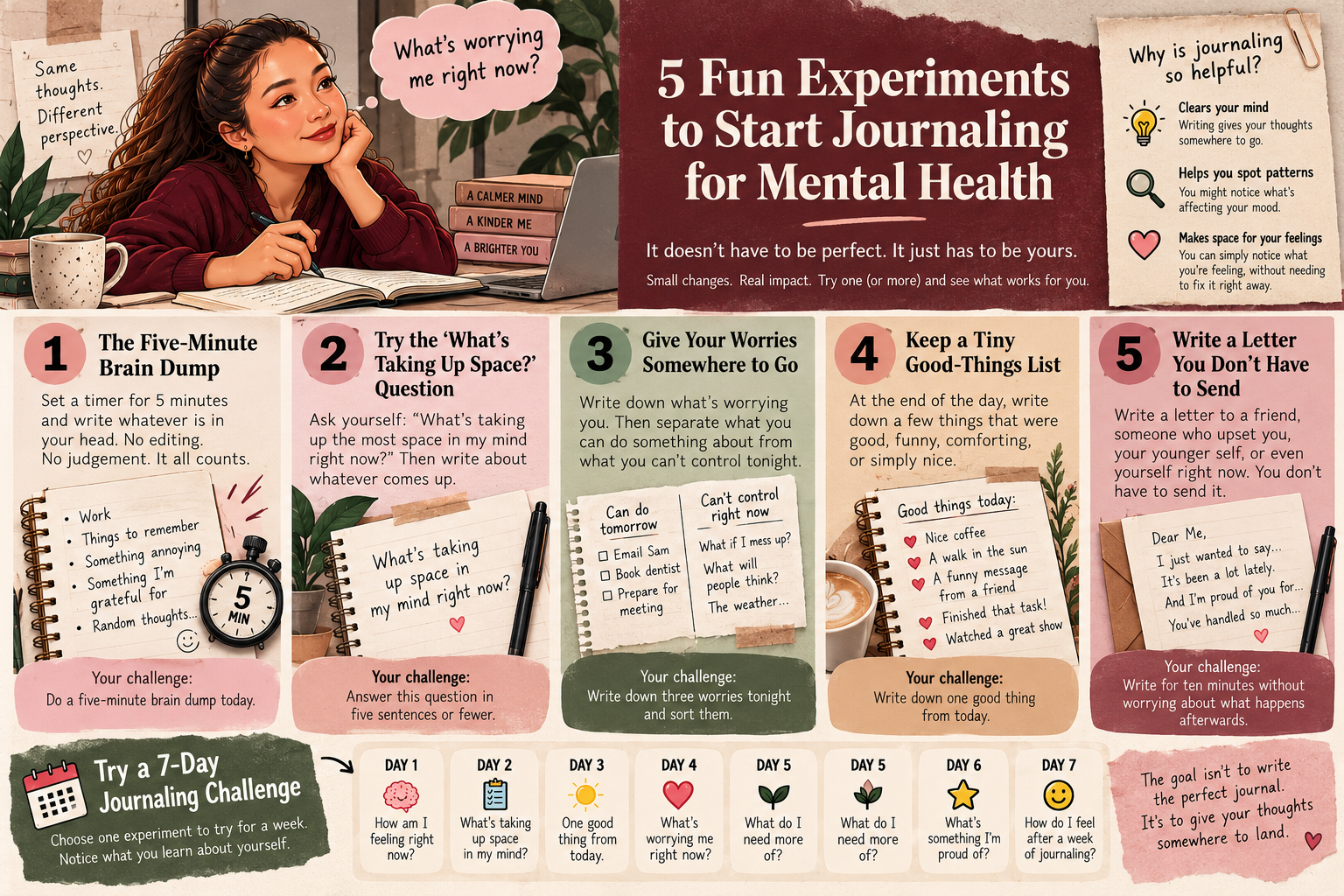
Five experiments to help you start journaling
You don't need a fancy journal system.
You don't need to write every morning at 5am while drinking something green.
Let's start smaller.
Think of these as experiments, not rules. Try one, see what happens, and keep what works.
1. The Five-Minute Brain Dump
Set a timer for five minutes.
Write whatever is in your head.
Work.
Relationships.
Things you need to remember.
Something annoying someone said.
Something you're looking forward to.
The fact that you really need to buy toothpaste.
It all counts.
Don't organise it.
Don't judge it.
Just get it onto the page.
Your challenge: Do a five-minute brain dump once today.
When the timer ends, you can stop.
2. Try the “What's Taking Up Space?” Question
Sometimes you don't need a complicated journaling prompt.
You just need one good question.
Ask:
“What's taking up the most space in my mind right now?”
Then write about whatever comes up.
If the answer is work, write about work.
If it's a relationship, write about that.
If it's something completely random, follow it.
You don't need to force yourself towards a particular topic.
Your challenge: Answer this question in five sentences or fewer.
You might find that five sentences are enough.
3. Give Your Worries Somewhere to Go
Ever try to fall asleep while your brain produces a list of everything you could possibly worry about?
Same brain.
Different hour.
A journal can be useful for getting those thoughts onto paper before bed.
Write down what's worrying you.
Then separate the things you can actually do something about from the things you can't control tonight.
For example:
I need to prepare for tomorrow's meeting.
That's actionable.
What if everyone thinks I'm terrible at my job?
That's a worry.
Writing them down doesn't solve everything, but it can make the difference between carrying the thoughts around in your head and seeing them clearly on the page.
Your challenge: Tonight, write down three things you're worried about.
Next to each one, write:
Can I do something about this tomorrow?
If yes, write the next small step.
If no, give yourself permission to leave it until tomorrow.
4. Keep a Tiny Good-Things List
Journaling doesn't have to focus entirely on problems.
At the end of the day, write down a few things that were good, funny, comforting, or simply nice.
Maybe someone made you laugh.
Maybe your lunch was excellent.
Maybe you finally finished something you've been putting off.
Maybe the weather was surprisingly lovely.
Maybe you had ten peaceful minutes with a cup of tea.
They don't have to be huge.
The point is to notice them.
Your challenge: Before bed, write down one thing from today that you'd like to remember.
One is enough.
5. Write a Letter You Don't Have to Send
Sometimes there's something you wish you could say.
To a friend.
To someone who upset you.
To your younger self.
Or even to yourself right now.
Write the letter.
Say everything you would want to say.
You don't have to send it.
You don't even have to keep it.
The point is to give the thoughts somewhere to exist outside your head.
You can be completely honest.
Nobody needs to read it.
Your challenge: Write for ten minutes without worrying about what happens to the letter afterwards.
You can save it, tear it up, or close the notebook and move on.
What if you don't feel like journaling?
You probably won't.
Some days you'll open the notebook and have nothing to say.
That's fine.
You don't have to force yourself to write a page every day.
You can write one sentence.
You can answer one question.
You can make a list.
You can draw.
You can write:
“I don't feel like journaling today.”
Congratulations.
You just journaled.
The goal isn't to create another task you can feel guilty about failing to complete.
It's to have a tool you can use when it feels helpful.
If morning journaling works for you, keep it.
If you prefer writing before bed, do that.
If five minutes feels manageable and 30 minutes feels like homework, stick with five.
You don't have to do it perfectly.
Your seven-day journaling challenge
Want to make this practical?
Choose one journaling experiment and try it for a week.
Before you begin, notice how you're feeling.
You could even give yourself a simple rating from 1 to 10 for your current stress level.
Then choose one small habit.
Maybe you'll write for five minutes each evening.
Maybe you'll answer one prompt each morning.
Maybe you'll write down one thing you're grateful for before bed.
At the end of the week, check in with yourself.
Ask:
- Did writing help me understand my thoughts?
- Did I notice any patterns?
- Did I feel any different after writing?
- Was five minutes enough, or would another approach work better?
You don't need to prove that journaling works.
You're simply finding out whether it works for you.
If one experiment feels useful, keep it.
If it doesn't, try another.
That's the point.
A final thought
You don't need a perfect notebook.
You don't need beautiful handwriting.
You don't need to know exactly what you're feeling before you start writing.
You just need a page.
Start with what's already in your head.
Write the messy version.
Write the sentence you don't know how to finish.
Write the thing you've been avoiding thinking about.
And if your first entry is:
“I have no idea what I'm doing, but apparently I'm journaling now.”
That's a perfectly good place to start.
The goal isn't to write the perfect journal. It's to give your thoughts somewhere to land.